C A R M A X
Growing into a new role
A look back on spending a year in a leadership development program.
Kick Off Thoughts
I didn't enter the Senior Management Development Program originally because I wanted to become a people manager. I entered because I wanted to become a stronger principal designer—someone who could lead through influence, create clarity, and make meaningful impact across teams without formal authority.
That distinction mattered. It shaped everything about how I approached the program.
As a Lead Product Designer at CarMax with six years under my belt, I'd gotten comfortable executing on my own. I could solve problems, ship designs, and deliver for my team. But I was starting to hit a ceiling. The work I wanted to do—the kind that creates systemic change and elevates entire teams—required a different set of muscles. Muscles I hadn't fully developed yet.
SMDP gave me the structure to build them.
What SMDP Actually Is
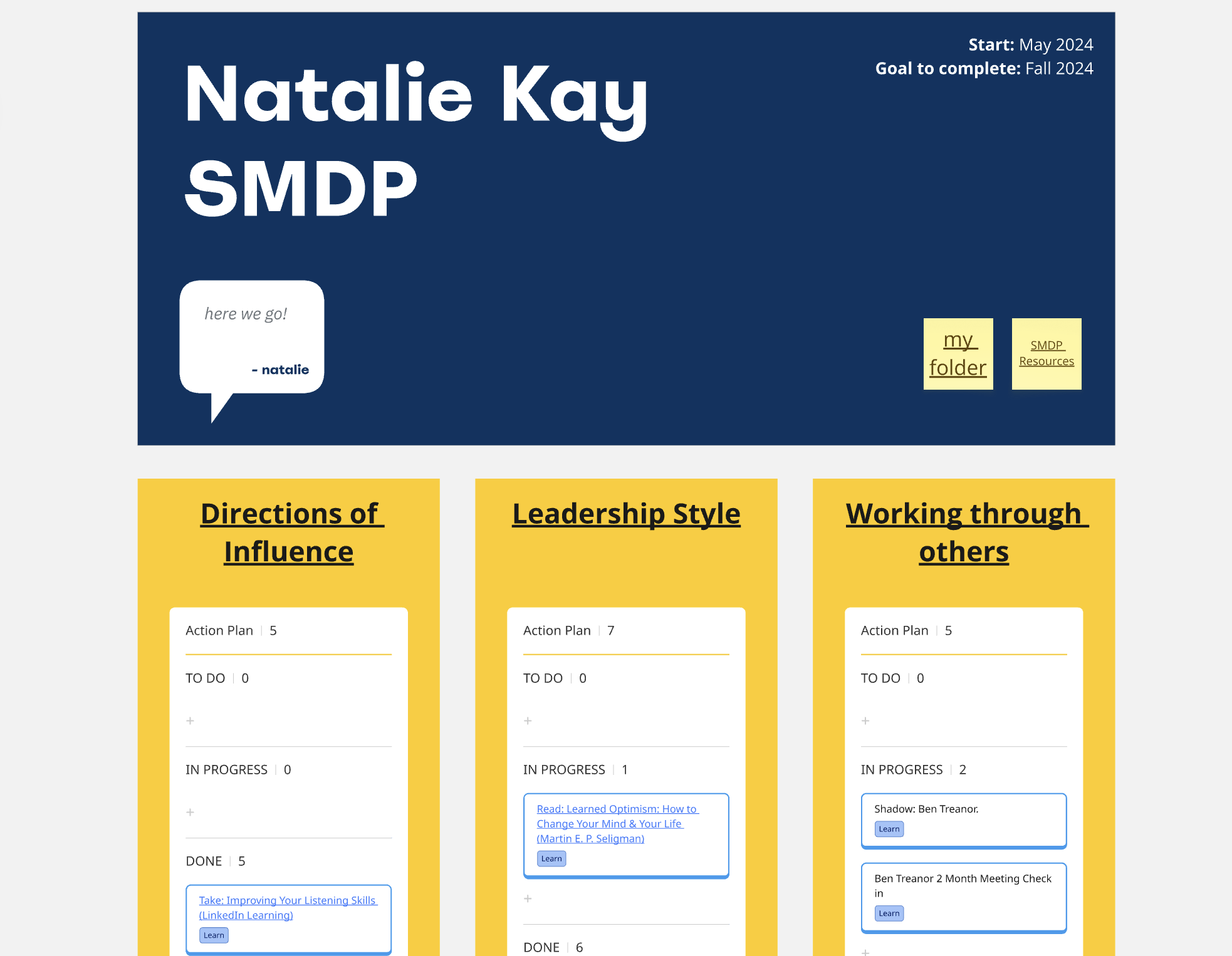
The Senior Management Development Program isn't a traditional training course. It's an 8–13 month, high-accountability development experience designed to prepare CarMax associates for Sr. Manager roles through real work, not classroom theory.
The program has three phases:
Explore (1–2 months): Assess readiness, identify gaps, and create three Individual Development Plans (IDPs) aligned to Sr. Manager competencies.
Develop (4–8 months): Work through learning modules, execute your IDPs through real projects, complete on-the-job reviews, and participate in leadership consults.
Experience (3 months): Transition support, peer networking, and sustained learning.
What makes SMDP different is its participant-owned, feedback-rich structure. You drive your own development. You coordinate your reviews. You demonstrate growth through actual impact, culminating in a Capstone presentation where you show—not tell—how you've grown.
For me, that meant choosing three IDPs that felt critical for leading as an individual contributor: Working Through Others, Directions of Influence, and Leadership Style.
Working Through Others: Learning to Let Go
I chose "Working Through Others" because I recognized a pattern in myself: I was good at getting things done alone, but I wasn't always leveraging the full potential of the people around me.
If I wanted to be seen as a leader—even without direct reports—I needed to become someone who empowers others, not just someone who executes efficiently.
What I Learned
Through shadowing other leaders and digging into frameworks around collaboration, I learned that working through others requires three things:
Building authentic relationships
Being intentional about communication
Giving people space to take ownership
The real test came when I took on reorganizing our Figma architecture for the entire design team—over 60 designers.
Figma is the core tool we use for design work at CarMax. Think of it like Microsoft Word for writers—except we all work in the same ecosystem together. The problem? Our structure was chaos. Sixty-five scattered teams, inconsistent naming, siloed approaches. It was hard to collaborate. Hard to find things. Hard to onboard new people.
I could have just audited the mess and imposed a new structure. That's what the old me would have done.
Instead, I sat down individually with senior design managers to understand what was working and what wasn't. I used their feedback to define a new organizational model—cutting it down to 25 clear, aligned spaces—but then I gave those managers flexibility in how they implemented it within their teams.
For some teams, I facilitated workshops. For others, I created self-service guides. I announced changes early and invited feedback throughout.
The result? Not just a cleaner system, but stronger team engagement. I still get messages from designers telling me how much easier collaboration has become.
What Changed in Me
I learned to delegate. To trust. To create shared ownership.
When people feel involved, they show up differently—and better outcomes follow. This is a skill I'll carry forward, especially in a cross-functional role where I don't have positional power.
What I Learned
Influence starts with trust. I explored frameworks around credibility and authenticity, leaned into active listening strategies, and conducted interviews with leaders like Chip Stevens and Susan Stavitski to understand how they navigate hard conversations.
One insight stuck with me: preparation and documentation are acts of respect. When you show up ready, people listen differently.
Putting It Into Practice
I applied this during work on the Associate Facing Design Library. A group of us design internal tools for CarMax associates, and we try to align on shared design elements so those tools feel consistent and intuitive.
We were facing a tricky challenge: how to restructure the left-hand navigation to allow for deeper, more flexible sub-navigation. It wasn't a simple update—there were different perspectives, preferences, and constraints across product teams.
I led discussions with designers and product teams, used active listening to surface concerns, and proposed updates that balanced competing needs. I provided clear documentation and examples to guide adoption. When feedback came in, I worked one-on-one with people to adjust and improve the design.
Then, midstream, our entire direction shifted. We decided to adopt Material UI—a new shared design system. Rather than see this as a setback, I leaned into it as another opportunity to influence how our new library would support similar functionality moving forward.
What Changed in Me
I learned that influence isn't about winning every debate. It's about how you show up. Am I prepared? Am I listening? Am I building bridges?
I've become more confident navigating complex discussions and advocating for what matters—without steamrolling anyone. That's a different kind of power.
Directions of Influence:
Building Bridges, Not Walls
I chose "Directions of Influence" because principal designers need to influence across teams and up to leadership. We live in the space between strategy and execution, and if we can't build alignment, we can't move anything forward.
Leadership Style:
Creating Clarity in Complexity
I chose "Leadership Style" because I wanted to get better at helping teams stay focused and motivated, especially during uncertainty.
I've always cared about how decisions affect people—but I wanted to be more intentional about how I communicate during tough moments.
What I Learned
Through exploring concepts like optimism bias and the emotional dimensions of feedback, I learned that leadership is about creating clarity when things feel murky. It's about framing possibility without ignoring reality.
Good leaders don't just deliver information—they shape how people feel about moving forward together.
The Title Experience Vision
One of the most fulfilling applications of this IDP was leading the Title Experience Vision work.
Car titles aren't glamorous. But they're essential—actually more valuable than the physical vehicle itself. A title is the piece of paper that proves we own the car and can sell it. Without clear title processes, nothing moves.
The problem? Teams across strategy, product, engineering, operations, and design weren't aligned on what "good" looked like for title work. There was no shared vision.
I partnered with a design manager and another senior designer to craft a compelling story about the future of title work—why it matters, what it could become, and how we might get there. We used storytelling to bring a North Star to life.
Then I facilitated feedback sessions with directors across all those functions. We iterated together. We refined the message. And slowly, the conversation shifted from "Why does title work matter?" to "How can we make this better?"
What made this work so fulfilling was watching mindsets change. By grounding everything in a clear vision and showing how each person's role contributed to the bigger picture, we moved forward together.
What Changed in Me
I learned that leadership isn't about having all the answers. It's about creating clarity, building trust, and helping others see possibility—even in complexity.
I don't need to know everything. I need to know how to frame the right questions and invite people into solving them together.
What this development program taught me…
-
SMDP has been transformational—not because I earned a promotion, but because I fundamentally changed how I show up.
I've learned that I don't need a formal manager title to lead. I need clarity, empathy, and a commitment to collaboration.
Through these three IDPs, I've grown more confident working through others, more thoughtful in how I influence, and more grounded in how I lead. I've built authentic relationships, learned to prepare with intention, and discovered that vulnerability—not perfection—builds trust.
-
If I'm honest? I'd push myself to seek feedback earlier and more often. There were moments where I waited too long to course-correct because I wanted to "get it right" first. But some of my biggest growth came from the discomfort of hearing hard truths in those on-the-job reviews.
I'd also give myself more grace. This program is intense. It asks you to stretch in ways that feel uncomfortable. I spent a lot of energy trying to appear like I had it all figured out, when the real learning was happening in the messy middle.
-
I'll keep refining these skills. I'll continue seeking feedback, leaning into ambiguity, and showing up with curiosity and courage.
Whether I'm shaping design systems for our 60+ person team, driving vision work across programs, or supporting my peers, I know these foundations will help me lead with impact.
And maybe that's the point. Leadership isn't a destination. It's a practice. SMDP gave me the structure to build that practice—and the confidence to keep iterating on it.
Why This Matters
This case study isn't about a product I designed or a feature I shipped. It's about the work of becoming the kind of leader people want to follow, not because of a title, but because of how I show up.
That's harder to measure than quarterly metrics. But it's the work that compounds even in my personal life. And, to me, it's the work that makes everything else possible and some of the work I'm most proud of.